
Whole House Repiping in Kitsap County, WA
Repiping a house is disruptive, and it is the kind of job that gets done once in a generation. PEX repiping, copper work, and targeted pipe repair for homes throughout the West Sound: we replace what has failed and what is about to, tell you which is which, and put the house back together in a way you do not have to think about again.
- Third generation in the trades
- Kitsap local. No ferry, no Narrows.
- Done right, Labor backed by a full year



- Third generation in the trades
- Kitsap local. No ferry, no Narrows.
- Done right, Labor backed by a full year
- Third generation in the trades
- Kitsap local. No ferry, no Narrows.
- Done right, Labor backed by a full year
- Third generation in the trades
- Kitsap local. No ferry, no Narrows.
- Done right, Labor backed by a full year

When a House |Needs Repiping|
Galvanized Steel
Galvanized supply pipe is the most common reason a house here needs whole house repiping. It rusts closed from the inside, and the bore narrows over decades until pressure at the fixture is a fraction of what the house was built with, and the threads at each fitting are where it eventually gives way. Plenty of pre-war and mid-century stock on this side of the water still has it behind the plaster.
Once galvanized has started failing at one fitting, the rest of the system is the same age and has had the same water through it.
Polybutylene
Grey polybutylene went into a great many houses built between the late seventies and the mid nineties, and it has a reputation for letting go without notice. There is often no drip, no stain, and no warning before a fitting lets go. Where a house still has it, planned replacement is a considerably better experience than the unplanned version.
Copper That Has Started Pinholing
One pinhole in copper is a system-wide signal, not a single fault, and the chemistry behind it is set out on our leak detection page. What matters for a repipe decision is the pattern: if it has happened more than once, you are patching a system that will keep asking.
What Gets Replaced, |and What Does Not|
Supply Lines and Drains Are Different Jobs
A repipe normally means the pressurised supply side, the hot and cold lines feeding every fixture in the house. Drain, waste, and vent piping is a separate system with separate failure modes, and plenty of houses need one without needing the other.
We tell you which of the two you are actually looking at rather than quoting both by default.
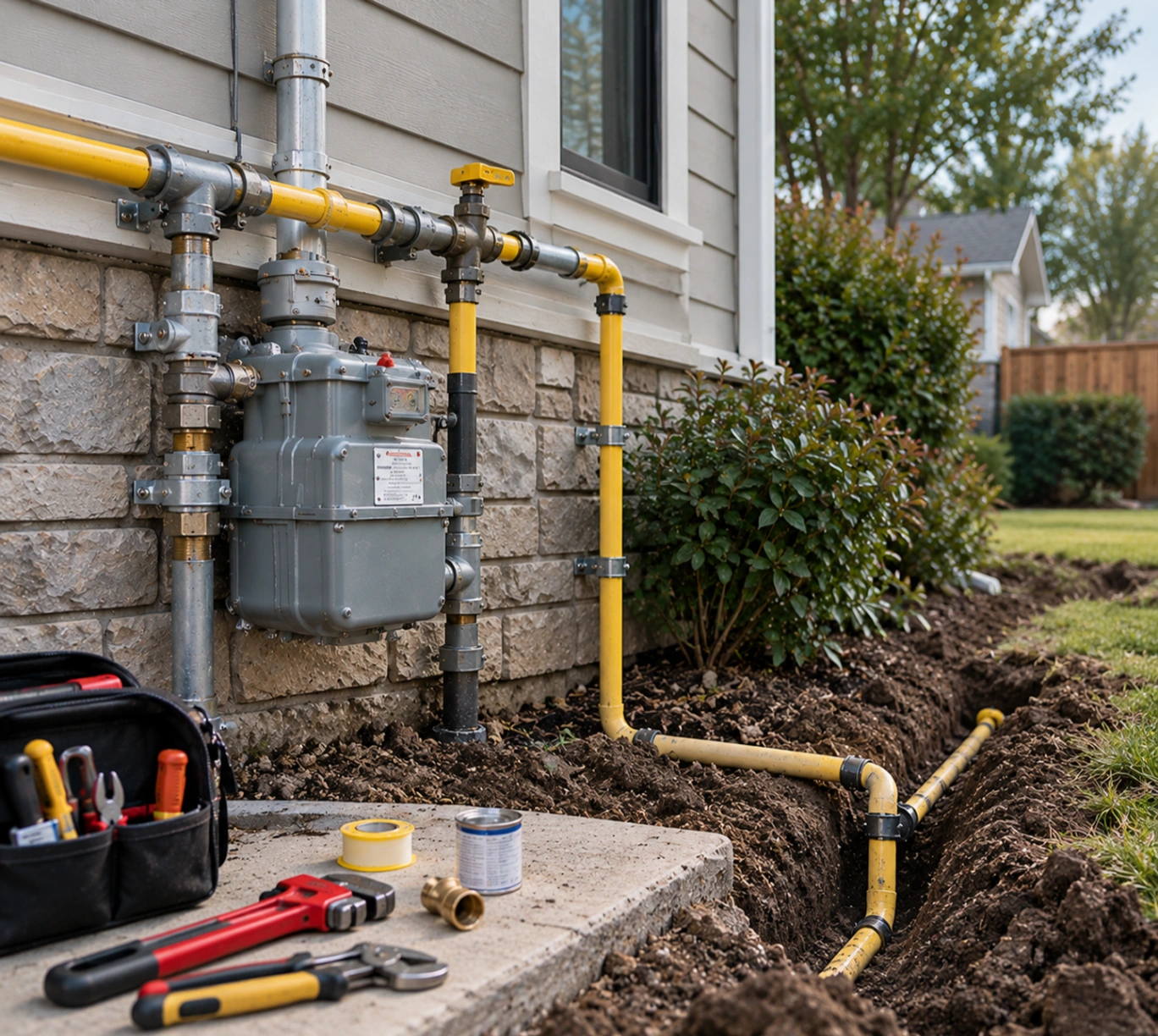
The Main Water Line to the House
The service line running from the meter to the house is its own job. An undersized or failing main can be the actual reason for poor pressure throughout a house, in which case repiping the interior alone would not fix the complaint. What method suits a service line replacement depends on its length, depth, route, and what sits above it, and that gets decided after we have looked rather than in advance.
Partial Repipes and Single Runs
Not every house needs everything done. A single failed run, one bathroom group, or the section that keeps giving trouble can be replaced on its own.
That is often the honest recommendation on a house with mixed materials, where a previous owner already replaced part of the system and only the original runs are at the end of their life.

PEX or |Copper|
Why Most Repipes Here Go in PEX
PEX is flexible, which is what makes whole house repiping survivable in an occupied home. Long runs can be pulled through existing framing cavities with far fewer openings than rigid pipe requires, so there is less wall to cut and less to put back.
It also handles aggressive water better than copper does, which matters a great deal on a private well, and it tolerates a hard freeze with more forgiveness. On a peninsula house that sits empty through part of the winter, that second point is worth more than it sounds.
When Copper Still Makes Sense
Copper is still the right call in some situations, including exposed runs where appearance matters, certain connections near a water heater, and houses where a homeowner simply prefers it and the water chemistry supports it. It is a real choice rather than a default, and you get the trade-offs both ways before deciding.

Living in the |House While It Happens|
How Long You Are Without Water
Not the whole project, and that surprises people. Water goes off while the changeover happens, not for the duration of the work. Most of a repipe is running new lines alongside the old ones, which does not require the house to be dry. We tell you the day before which hours are affected, and we do not leave a house without water overnight.
Walls, Ceilings, and Access
Openings get planned, not improvised. We work out the routes first and cut deliberately in the places that cause least disruption, usually in closets, garages, and low-visibility spots rather than the middle of a finished wall. Crawl spaces and attics do a lot of the work for us on peninsula houses.
We make the openings; we do not do the drywall finish. Patching, texture, and paint go to the general contractor Alex works alongside, who does that properly rather than approximately. You are not left holding two disconnected trades.
Sequencing Around Your Week
A repipe is planned work, so it gets scheduled around you. Bathrooms and the kitchen get sequenced so the house stays usable, and if there is a day that genuinely cannot be disrupted, say so at the quote stage and it gets built into the plan.
What Drives |the Cost|
Size, Access, and Finish
Fixture count and layout set the scale of a whole house repiping job, then access decides how hard it is. A single-storey house over a generous crawl space is a very different proposition from a two-storey with finished ceilings below every bathroom. Slab construction, tight attics, and tile work all push it. So does the standard of finish going back afterward.
We do not publish repiping figures, because the range between an easy house and a difficult one is wide enough that any number would mislead one of you.
What Is Included
New supply runs, fittings, valves, connections at every fixture, pressure testing, and the permit. Shut-off valves get replaced while the walls are open, because doing that later means opening them again. What is not included is the drywall finish, which is coordinated rather than absorbed. The deals page is worth a look before you sign off the scope, since a repipe is the size of the job where they count.
Getting It |Signed Off|
Permits and Inspection
A repipe is permitted and inspected work. The inspection is the check on everything that is about to be covered up, which is precisely why it matters more on this job than on most. Across four years of A to Z jobs, none has failed inspection.
After the Last Wall Goes Back
A full year on parts and labor stands behind the work, and the house gets left clean at the end of every day rather than only at the end of the job. Because the trucks start out here, whole house repiping in Silverdale, Port Orchard, Poulsbo, Gig Harbor, and Belfair fits around your calendar rather than a sailing time. Several of our reviews come from repipe customers, which is the nearest thing to a reference on a job this size.
What Kitsap Says: "Wish We'd Found You Sooner"
See what homeowners around Kitsap have to say about working with Alex and the A to Z team.

A to Z plumbing is by far the best plumbing company out there. They are so fast to respond to your issues. They are reasonably priced and won’t charge you for things you don’t need. 100% recommend.

August 23, 2023

Alex and Michael have done outstanding work on three different plumbing issues. They respond quickly to scheduling work, show up on time, and work efficiently. They are very knowledgeable about each issue I presented. They quote pricing up front so there are no surprises. They are fair in their pricing. They are friendly and always leave a clean work area. I would highly recommend A to Z Plumbing. I know we will ALWAYS call them for any plumbing needs.
July 17, 2024
Great customer service, quality workmanship and Alex is just a great guy to work with.
August 8, 2026
My husband and I are very pleased with Alex’s work. He is very professional and trustworthy We enjoyed working with him. We will definitely use him again and be happy to refer him and his company to anyone looking for a reliable and service-oriented plumber!
September 9, 2025
Alex and Tanner were amazing! We had an interesting, and I would say challenging, situation that needed to be addressed in several ways. They were both professional and competent. Alex returned messages and calls promptly, and addressed all the hiccups we encountered quickly. He is a kind and honorable person – we are SO glad we called A to Z plumbing, and will absolutely call them for all our plumbing needs!
September 9, 2025
10/10 Would recommend. A to Z plumbing came out to repair a busted water main for me as an emergency service. Alex and his team arrived within 15 minutes of my emergency and remained cool, calm and collected. They worked together to solve the problem quickly and efficiently. They were knowledgeable and professional from start to finish. I couldn’t be happier with their service and I will be using them again for future plumbing related services. A to Z plumbing had clear pricing that was consistent with their industry. If you want something done right, don”t do it yourself. Just call A to Z plumbing and enjoy your peace of mind.
March 9, 2026


Questions Homeowners Ask Before We Come Out
Do I have to move out during a repipe?
Almost never. The work happens around you, water is only off during the changeover rather than for the whole project, and the house does not get left dry overnight. Families stay put through most of these.
Is PEX as good as copper?
For most houses here it is the better choice, not a compromise. It handles aggressive water better than copper, tolerates freezing with more give, and needs far fewer wall openings to install, which means less to repair afterward. Copper still wins in specific situations and we will tell you when yours is one.
How do I know if I have polybutylene?
It is usually grey, flexible, and stamped PB2110, and it turns up most often in construction from the 1980s and early 90s. Check where the pipe is visible at the water heater or in a crawl space. If you find it, that is worth a conversation before it makes the decision for you.
Does the price include putting the drywall back?
No, and it is better to be clear about that up front. We make the access openings and coordinate the patching, texture, and paint with the general contractor we work alongside. He does finish work properly. What you avoid is being handed two separate trades and asked to manage the gap between them.
Will repiping fix my water pressure?
Often, when the cause is galvanized pipe that has rusted closed, because restoring the bore restores the flow. Sometimes the restriction is the service line from the meter instead, and replacing interior pipe alone would not solve it. We check which before recommending either.
Do you replace the water line from the meter to the house?
Yes, that is a job we take. The right approach depends on the route, the depth, and what is on the surface above it, so it gets decided after we have seen it rather than quoted blind.