
Water Filtration in Kitsap County, WA
Nobody should be sold a water treatment system before anyone has found out what is in the water. A free test comes first, read against what your well or your supply is actually doing, and the equipment gets sized to those numbers. Whole house water filtration, iron and manganese removal, sediment filtration, and drinking water systems for households throughout Kitsap, Mason, and Pierce County.
- Third generation in the trades
- Kitsap local. No ferry, no Narrows.
- Done right, Labor backed by a full year



- Third generation in the trades
- Kitsap local. No ferry, no Narrows.
- Done right, Labor backed by a full year
- Third generation in the trades
- Kitsap local. No ferry, no Narrows.
- Done right, Labor backed by a full year
- Third generation in the trades
- Kitsap local. No ferry, no Narrows.
- Done right, Labor backed by a full year
Start With a Test, |Not a System|
The Free Water Test
Water filtration starts with a test, and the test is free. It tells you what you are dealing with and it tells us what, if anything, is worth installing. Sometimes the answer is a single sediment filter. Sometimes it is nothing at all, and we would rather tell you that than fit equipment your water does not need.
What the Kitsap 5 Covers
Kitsap Public Health uses a standard local panel known as the Kitsap 5: iron, manganese, nitrate, chloride, and conductivity. It is what the Health District requires on a chemical analysis for a private well, and between them those five say a great deal about what your water will do to your plumbing and your fixtures.
The Health District also recommends private well owners test for bacteria every year and nitrate every three years. That cadence is worth keeping regardless of whether you ever install treatment.
Those numbers are what specify equipment. Iron at one level is a cartridge problem and at another it needs dedicated media. Sizing water filtration to a guess means either paying for capacity you never use or watching it fall behind inside a year.

If You Are on a |Private Well|
Nobody Is Treating It But You
A great many households out past the city limits here draw from a private well, and a private well is untreated and unmonitored unless the owner does something about it. There is no utility running disinfection or corrosion control on your behalf. That is not alarming, it is simply the arrangement, and it puts the testing decision in your hands.
The Health District’s own numbers give some sense of scale. Of 442 private water status reports completed across the county in 2025, 194 identified significant problems. Those reports cover the well system rather than only the water, but the proportion is a fair argument for knowing where yours stands.
Iron and Manganese
These two are behind most of what people actually notice. Orange or brown staining in sinks, tubs, and toilet bowls is usually iron. Black or grey specking and staining is usually manganese. Both foul cartridges and valves over time, and both are entirely treatable once a test says how much of each you have.
Coastal and Waterfront Wells
Chloride and conductivity are on the Kitsap 5 for a reason. Wells near the shoreline can be affected by seawater intrusion, and high chloride is both a treatment question and a plumbing one, because chloride-heavy water is hard on metal. On waterfront property those two numbers are the ones to watch across seasons rather than once.


If You Are |on City Water|
What Bremerton Already Does
The municipal supply here is well run and it is worth saying so plainly. Bremerton draws from a protected watershed the city owns and patrols, treats with disinfection, and runs corrosion control specifically so the water is not aggressive toward the pipes inside your walls. It is one of a small number of surface water systems in the country not required to filter, and its source protection work has been recognised nationally.
If you are on city water, you do not have a problem to solve. You may still have a preference.
What People Still Choose to Filter
Taste and smell are the usual reasons, particularly chlorine taste at the tap, and that is a legitimate thing to want gone. A drinking water system at the kitchen sink handles it without touching the rest of the house. Some households also filter for sediment where an older service line is shedding into the supply.
What Goes |In, and Where|
Sediment Filtration
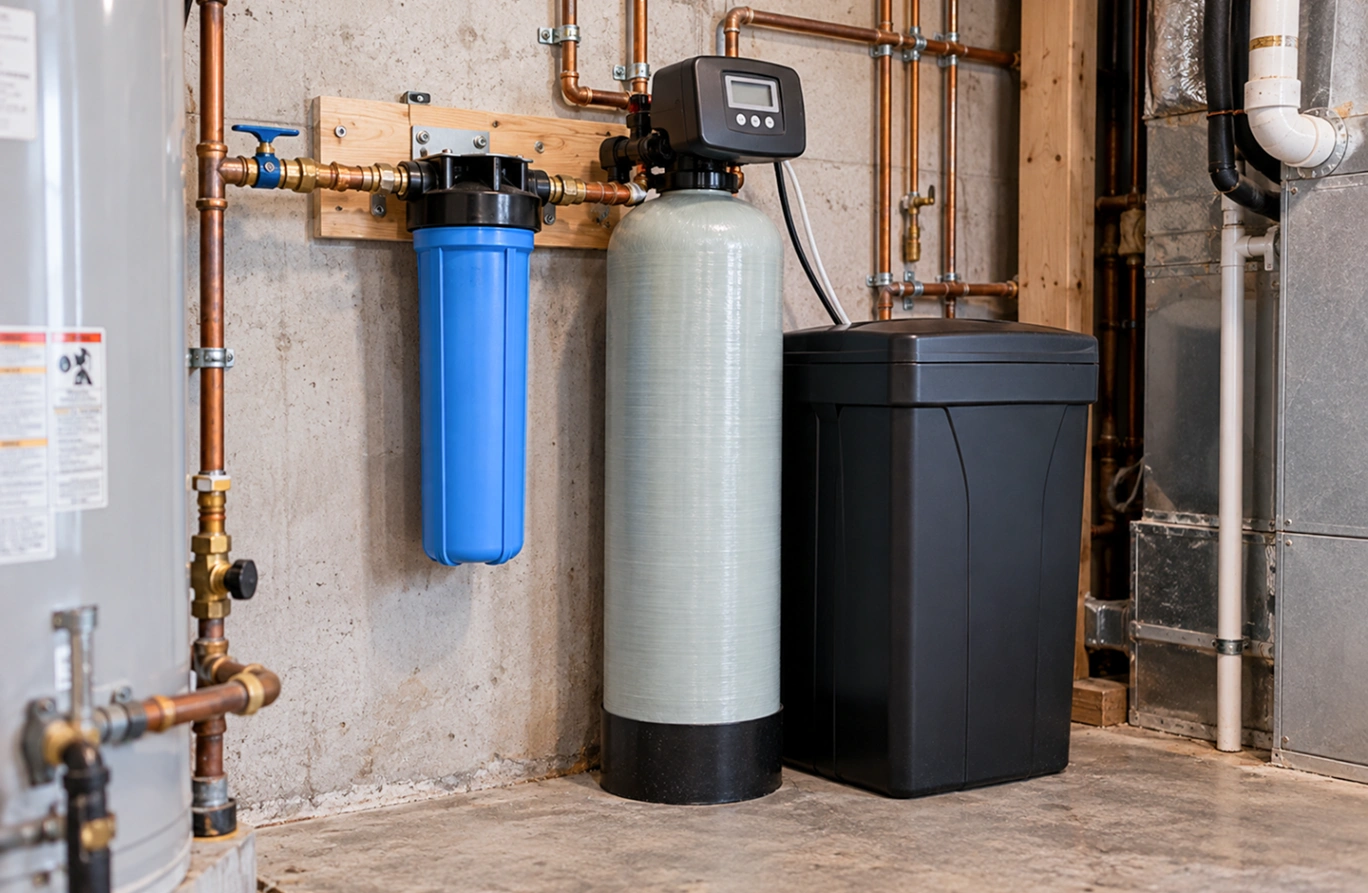
A sediment filter is the first stage in most systems and often the whole answer on its own. It catches sand, grit, rust particles, and the silt a well can pull after heavy rain, which protects everything downstream of it including your fixtures and your water heater.
Iron and Manganese Removal
Above a certain level these need dedicated media rather than a cartridge, because a cartridge simply loads up and stops working. The media type and the size depend on your test numbers and on how much water the household actually uses.
Reverse Osmosis at the Tap
Reverse osmosis is point-of-use rather than the whole house. It sits under the kitchen sink, treats the water you drink and cook with, and produces very clean water at a low flow rate. Treating an entire house by reverse osmosis is neither necessary nor sensible for most households, and anyone proposing it should be asked why.
Filtration and Softening Are Different Jobs
Filtration removes things from the water. Softening changes how the water behaves. Hardness is a scale problem rather than a contaminant problem, and a filter will not address it, which is what water softeners are for. Plenty of houses here want one, some want both, and the test tells us which conversation to have.

Installing It and Keeping It Working
Where the Equipment Goes
Whole house water filtration goes in near where the water enters, ahead of the branches feeding the house, which usually means a garage, a utility space, or a crawl space. Getting the order of stages right matters, and so does leaving room to service it. A system nobody can reach is a system nobody maintains.
Bypass valves go in as standard, so a cartridge change or a fault does not leave the house without water.
Cartridges, Media, and Service Intervals
Every system needs upkeep and the interval depends on your water. A cartridge on heavily loaded well water works far harder than the same cartridge on a light load. We give you the realistic schedule for your own results, and we will either service it or show you how.
Cost and What |Comes With It|
What Drives the Price
Test results set the water filtration specification, and the specification sets the cost. Sediment only is modest. Iron and manganese media, multiple stages, or a system sized for a large household is a bigger install. Where the equipment has to sit, and what plumbing has to change to get it there, is the other half.
We do not publish system prices, because quoting treatment before testing is exactly the practice this page exists to avoid.
Behind the Install
A full year on parts and labor, a system sized to real numbers, and honest advice about when you do not need one. Alex works with an established filtration supplier and installs across Silverdale, Port Orchard, Poulsbo, Gig Harbor, and Belfair. Any deals in play get applied once the specification is settled.
What Kitsap Says: "Wish We'd Found You Sooner"
See what homeowners around Kitsap have to say about working with Alex and the A to Z team.

A to Z plumbing is by far the best plumbing company out there. They are so fast to respond to your issues. They are reasonably priced and won’t charge you for things you don’t need. 100% recommend.

August 23, 2023

Alex and Michael have done outstanding work on three different plumbing issues. They respond quickly to scheduling work, show up on time, and work efficiently. They are very knowledgeable about each issue I presented. They quote pricing up front so there are no surprises. They are fair in their pricing. They are friendly and always leave a clean work area. I would highly recommend A to Z Plumbing. I know we will ALWAYS call them for any plumbing needs.
July 17, 2024
Great customer service, quality workmanship and Alex is just a great guy to work with.
August 8, 2026
My husband and I are very pleased with Alex’s work. He is very professional and trustworthy We enjoyed working with him. We will definitely use him again and be happy to refer him and his company to anyone looking for a reliable and service-oriented plumber!
September 9, 2025
Alex and Tanner were amazing! We had an interesting, and I would say challenging, situation that needed to be addressed in several ways. They were both professional and competent. Alex returned messages and calls promptly, and addressed all the hiccups we encountered quickly. He is a kind and honorable person – we are SO glad we called A to Z plumbing, and will absolutely call them for all our plumbing needs!
September 9, 2025
10/10 Would recommend. A to Z plumbing came out to repair a busted water main for me as an emergency service. Alex and his team arrived within 15 minutes of my emergency and remained cool, calm and collected. They worked together to solve the problem quickly and efficiently. They were knowledgeable and professional from start to finish. I couldn’t be happier with their service and I will be using them again for future plumbing related services. A to Z plumbing had clear pricing that was consistent with their industry. If you want something done right, don”t do it yourself. Just call A to Z plumbing and enjoy your peace of mind.
March 9, 2026


Questions Homeowners Ask Before We Come Out
Do I need a filter if I am on Bremerton city water?
Generally no, not for safety. The city treats a protected source and runs corrosion control so the water is gentle on household plumbing. People on city water who install something usually do it for chlorine taste at the drinking tap, which is a preference rather than a problem. We will not tell you otherwise to sell you a system.
How often should I test my well water?
Kitsap Public Health recommends bacteria annually and nitrate every three years for private wells. Beyond that, retest if the taste, smell, or appearance changes, after any work on the well, or after flooding. Coastal properties are worth watching for chloride across seasons rather than once.
What is the difference between a filter and a softener?
A filter takes things out of the water, such as sediment, iron, or manganese. A softener deals with hardness, which is not a contaminant but a behaviour: it is what leaves scale on fixtures and inside appliances. Different problems, different equipment, and the test tells you which you have.
Will filtration fix the rust stains in my sinks?
Usually, yes, if the cause is iron and the system is sized to the level in your water. Orange staining is typically iron, and dark specking is typically manganese. Both respond well to the right media, which is exactly the specification a test produces.
Does reverse osmosis waste water?
It does send some water to the drain as part of how it works, which is worth knowing before choosing it. That is one reason reverse osmosis makes sense at a kitchen tap for drinking and cooking rather than for the whole house. For most households the volume involved is small.
How often do cartridges need changing?
It depends entirely on what your water is carrying. Heavily loaded well water can go through a sediment cartridge in a few months, while a light load might run a year. We give you the interval for your results, and a bypass valve means changing one is a short job rather than an event.