Water Softener Installation in Kitsap County, WA
Hard water is a real problem with a real cost, and it is also the thing most easily sold to people who do not have it. We measure your hardness, tell you the number, and only then talk about equipment. Water softener installation, repair, and replacement for households across the peninsula, out to Belfair and Allyn, and over the bridges into Pierce.
- Third generation in the trades
- Kitsap local. No ferry, no Narrows.
- Done right, Labor backed by a full year



- Third generation in the trades
- Kitsap local. No ferry, no Narrows.
- Done right, Labor backed by a full year
- Third generation in the trades
- Kitsap local. No ferry, no Narrows.
- Done right, Labor backed by a full year
- Third generation in the trades
- Kitsap local. No ferry, no Narrows.
- Done right, Labor backed by a full year
What Hard Water |Actually Does|
Scale You Can See
Hardness is dissolved calcium and magnesium, and it leaves them behind everywhere the water sits or evaporates. Chalky white crust on faucet aerators and shower heads, cloudy film on glassware, spotting on a car after it dries, and a ring in the kettle are all the same mineral coming out of solution.
Scale You Cannot
The expensive version happens inside appliances. Scale forms fastest where water is heated, so it builds on a water heater element or across the bottom of a tank, insulating the burner from the water it is meant to heat. The unit works harder, runs longer, and gives you fewer years, which is why scale is a common reason traditional water heaters get replaced ahead of schedule.
It also collects in valve cartridges, fills the narrow passages of a mixing valve, and coats the inside of a tankless heat exchanger, which is why descaling intervals shorten on hard supply.
Soap, Spotting, and Laundry
Hardness fights detergent. Calcium binds with soap instead of lathering, which is why hard water households use more of everything and still see film on shower doors and dullness in laundry. It is the least expensive symptom and usually the first one people notice.
Find Out What |You Have First|
Hardness Is a Number, Not a Feeling
Hardness is measured in grains per gallon and it is either high enough to matter or it is not. Water is generally described as soft below about three and a half grains, moderate to about seven, and hard above that. Knowing which band your supply sits in decides whether a softener is worth having and, if so, what size.
We test before we specify. If the number comes back low, the honest recommendation is to keep your money.
Wells and the Municipal Supply Are Not the Same
Where your water comes from changes the answer. A private well drawing groundwater and a municipal supply drawing largely from surface water can sit in completely different hardness bands, so a neighbour’s experience is not evidence about your house. If your water also stains or smells, that is a separate question from hardness and belongs with water filtration rather than softening.

How a |Softener Works|
Ion Exchange and Regeneration
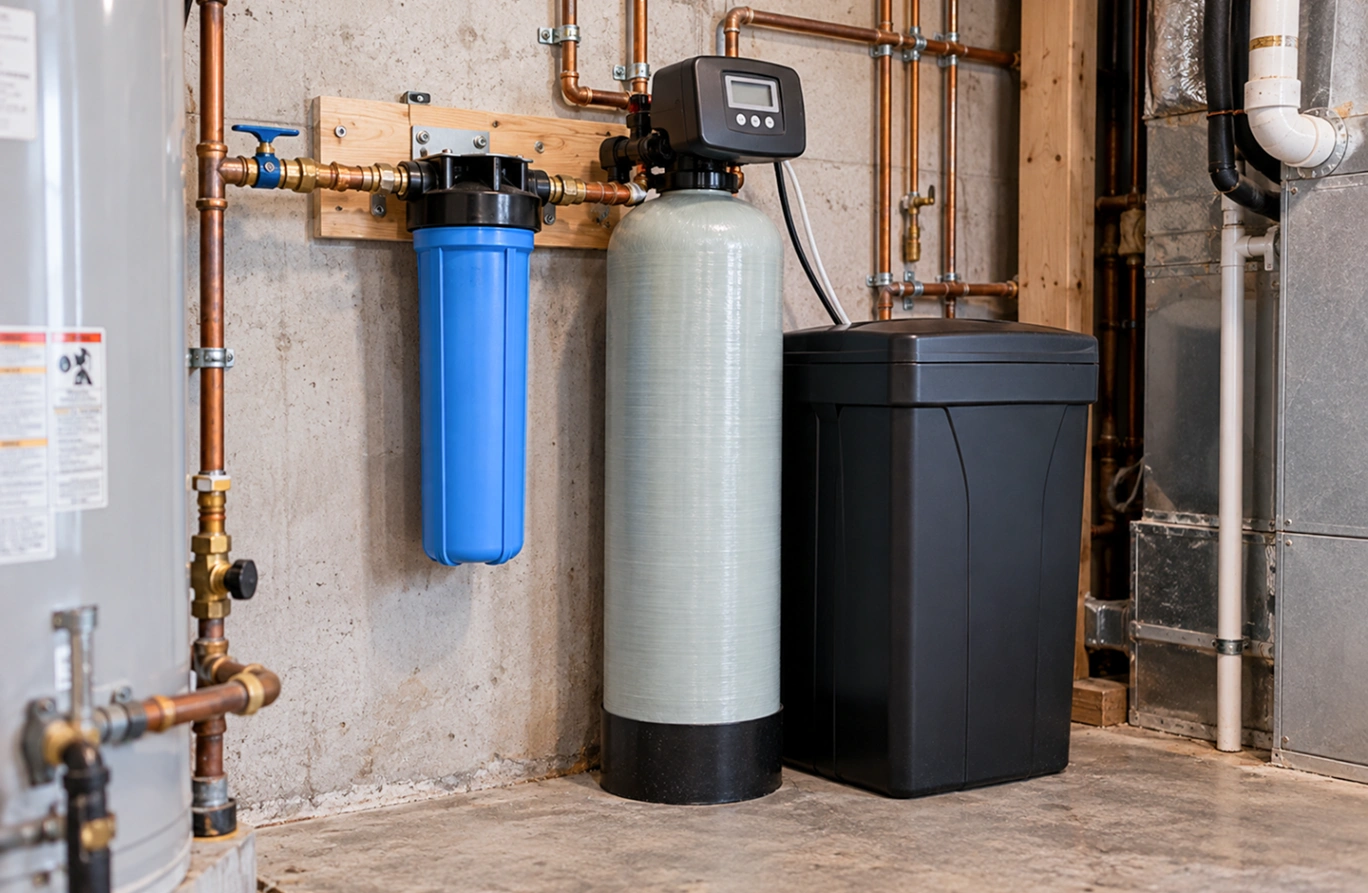
A water softener swaps the hardness minerals out rather than filtering them. Water passes through a resin bed that holds sodium or potassium ions and trades them for calcium and magnesium. When the resin fills up, the unit regenerates: it flushes brine from the salt tank through the bed, strips the hardness off, and sends it to the drain.
Better units regenerate on metered demand rather than on a timer, so they run when your household has actually used the capacity instead of every third night regardless.
Salt, and How Much It Uses
You are topping up a brine tank, not filling it constantly. How often depends on hardness, household size, and how efficiently the unit regenerates. A metered unit on moderate hardness in a small household is a bag every month or two; a timer-based unit on hard water with a family of five is considerably more.
Sizing by Grain Capacity
Sizing is hardness multiplied by how much water the household uses. Undersize it and it regenerates constantly, burning salt and water while still letting hardness through at peak. Oversize it and the resin sits too long between cycles. This is arithmetic rather than opinion, which is exactly why the test comes first.
Salt-Free |Systems, Honestly|
What a Conditioner Actually Does
A salt-free system is not a softener, whatever the box says. It does not remove calcium and magnesium, so the hardness number coming out is the same as the number going in. What these units do is alter how the minerals crystallise so they are less likely to stick to pipe and heating surfaces. The industry term for that is conditioning or scale prevention, not softening.
That distinction matters because it changes what you should expect. A conditioner may reduce scale in a water heater. It will not stop spotting on glassware or give you the slippery feel of softened water, because the minerals are still in the water.
When One Makes Sense
They have genuine advantages in the right situation. No salt to buy, no brine discharge, no regeneration water, and a much smaller footprint. If your concern is protecting a water heater and you would rather not run a drain line or handle salt, a conditioner is a reasonable choice, and we will fit one and tell you plainly what it will and will not do.

Installation |Details That Matter|
Where It Goes and What It Feeds
A water softener goes in near where water enters the house, ahead of the water heater so the hot side gets the benefit. Most installs leave at least one outside tap and often the kitchen cold tap on unsoftened water, because there is little sense softening a garden tap or the water going into a kettle.
It needs a drain within reach, a nearby power supply on most units, and enough room around the brine tank that filling it is not a wrestling match.
Discharge, Air Gaps, and Septic Systems
The discharge line is the part most often done badly. A softener drain must terminate with a proper air gap and never sit submerged in a standpipe or connect directly into waste, because that creates a cross connection between your drainage and your supply, which is the same hazard backflow installation exists to prevent.
On a septic-served property it deserves a conversation. A regeneration cycle sends a slug of salty water into the system, and given how many homes out in the unincorporated county are on septic, this comes up often. A metered, efficient unit reduces both the volume and the frequency, which is usually the right answer where a softener is genuinely needed.

Repair, Replacement|, and Upkeep|
When a Softener Stops Softening
When a water softener stops softening, the usual suspects are the salt bridge, the valve, and the resin. A hard crust can form across the brine tank so the unit thinks it has salt when the water below never reaches it. Control valves and their seals wear. Resin beds gradually lose capacity, and on iron-heavy water they foul faster, which is one more reason hardness and iron get looked at together.
Water softener repair is often worth it on a decent unit and rarely worth it on a cheap one past its middle age. We will tell you which yours is rather than defaulting to replacement.
After the Softener Goes In
A full year on parts and labor, a unit sized to your actual numbers, and no water softener installation sold to a household whose test says it does not need one. Alex works Silverdale, Port Orchard, Poulsbo, Gig Harbor, Belfair, and everywhere between. The deals page shows whatever is running when you book.
What Kitsap Says: "Wish We'd Found You Sooner"
See what homeowners around Kitsap have to say about working with Alex and the A to Z team.

A to Z plumbing is by far the best plumbing company out there. They are so fast to respond to your issues. They are reasonably priced and won’t charge you for things you don’t need. 100% recommend.

August 23, 2023

Alex and Michael have done outstanding work on three different plumbing issues. They respond quickly to scheduling work, show up on time, and work efficiently. They are very knowledgeable about each issue I presented. They quote pricing up front so there are no surprises. They are fair in their pricing. They are friendly and always leave a clean work area. I would highly recommend A to Z Plumbing. I know we will ALWAYS call them for any plumbing needs.
July 17, 2024
Great customer service, quality workmanship and Alex is just a great guy to work with.
August 8, 2026
My husband and I are very pleased with Alex’s work. He is very professional and trustworthy We enjoyed working with him. We will definitely use him again and be happy to refer him and his company to anyone looking for a reliable and service-oriented plumber!
September 9, 2025
Alex and Tanner were amazing! We had an interesting, and I would say challenging, situation that needed to be addressed in several ways. They were both professional and competent. Alex returned messages and calls promptly, and addressed all the hiccups we encountered quickly. He is a kind and honorable person – we are SO glad we called A to Z plumbing, and will absolutely call them for all our plumbing needs!
September 9, 2025
10/10 Would recommend. A to Z plumbing came out to repair a busted water main for me as an emergency service. Alex and his team arrived within 15 minutes of my emergency and remained cool, calm and collected. They worked together to solve the problem quickly and efficiently. They were knowledgeable and professional from start to finish. I couldn’t be happier with their service and I will be using them again for future plumbing related services. A to Z plumbing had clear pricing that was consistent with their industry. If you want something done right, don”t do it yourself. Just call A to Z plumbing and enjoy your peace of mind.
March 9, 2026


Questions Homeowners Ask Before We Come Out
How do I find out how hard my water is?
We test it, and that costs you nothing. Hardness is reported in grains per gallon, and the number tells you whether a softener is worth having and what size it would need to be. Guessing from how the water feels is not reliable, and neither is assuming yours matches a neighbour’s.
Do salt-free systems really work?
They do something, but not what most people think they are buying. They do not remove hardness, so the number in your water stays the same and you will still see spotting. What they can do is reduce how readily scale sticks inside appliances. If that is your goal they are a fair option, and if you want genuinely soft water they are not.
Is softened water safe to drink?
Ion exchange adds a small amount of sodium in proportion to the hardness it removes, so very hard water produces a more noticeable increase than moderately hard water. Most installs leave the kitchen cold tap unsoftened anyway. If someone in the house is on a sodium-restricted diet, a potassium chloride salt is an alternative worth raising with your doctor.
Can I have a softener if I am on a septic system?
Usually yes, and it is worth setting up properly rather than skipping the conversation. Regeneration discharges salty water into the system, so an efficient metered unit that regenerates only when needed is the sensible specification. Given how many properties out here are on septic, we deal with this regularly.
How much salt does a softener use?
It depends on your hardness, your household size, and how the unit regenerates. A metered unit on moderate hardness might be a bag every month or two. A timer-based unit on genuinely hard water with a large household will get through considerably more, which is one of the arguments for paying more up front for a metered valve.
My softener stopped working. Repair or replace?
Check the brine tank first for a salt bridge, which is a hard crust that keeps the water below from reaching the salt and is a common false alarm. Beyond that, a good unit with a valve or resin problem is often worth repairing. A budget unit well into its life usually is not, and we will say which one you have.