
Water Heater Replacement & Installation in Kitsap County, WA
Alex Cady has put in over a thousand water heaters himself, across roughly ten years on the tools, and in four years running A to Z not one job has failed a city inspection. Tank replacement, repair, and maintenance across the Kitsap Peninsula and the West Sound, with the permit pulled, the tank strapped to Washington code, and the old unit hauled away. No ferry between us and your garage.
- Third generation in the trades
- Kitsap local. No ferry, no Narrows.
- Done right, Labor backed by a full year



- Third generation in the trades
- Kitsap local. No ferry, no Narrows.
- Done right, Labor backed by a full year
- Third generation in the trades
- Kitsap local. No ferry, no Narrows.
- Done right, Labor backed by a full year
- Third generation in the trades
- Kitsap local. No ferry, no Narrows.
- Done right, Labor backed by a full year

Water Heater Installation Done Right the First Time
Choosing the Right Size for Your Household
Gallons are the wrong number to shop on. Washington sizes water heaters by first hour rating, which is how much hot water the unit can actually deliver in its busiest hour, and the state code table sets a minimum based on how many bedrooms and bathrooms your house has. A three bedroom, two bath home needs a first hour rating of 62 gallons, which is not the same thing as a 62 gallon tank.
Gas or electric usually isn’t a free choice. It depends on what is already at the house: a gas line and vent, or a circuit with the capacity to carry an electric unit. We’ll tell you what your house supports before anyone talks about upgrades.
Permitted, Code-Compliant Installs
We pull the permit. That means an inspector looks at the work, which is the point of having one. Four years in, no A to Z job has failed a city inspection.
Washington requires two seismic straps on a tank, one in the upper third of the unit and one in the lower third, with at least four inches of clearance above the controls. This is an earthquake country and the requirement is not optional.
Garage installs have their own rule. Burners and ignition sources have to sit at least eighteen inches above the floor unless the unit is listed as flammable vapor ignition resistant. Plenty of older Kitsap garages have a heater sitting flat on the slab that would not pass today.
What Install Day Looks Like
Shoe covers on, drop cloths down, old unit out. A standard water heater installation is usually a half day. We drain and pull the old heater, set and connect the new one, strap and vent it, fit an expansion tank if the system needs one, fill and purge the lines, then check for leaks before we pack up.
The old tank leaves on our truck. The floor gets wiped. That’s the Cleaner Than We Found It Promise, and it applies to a water heater swap the same as it applies to a full repipe.

Water Heater Repair to Get Your Hot Water Back
The Problems We See Most Weeks
No hot water at all is usually a failed heating element or thermostat on an electric unit, or a pilot, thermocouple, or gas control problem on a gas one. Not enough hot water, or hot water that runs out halfway through a shower, often points at a broken dip tube or sediment taking up room in the bottom of the tank.
Rumbling or popping is sediment: water trapped under a hardened layer at the base of the tank, boiling through it. Rusty hot water usually means the anode rod is spent and the tank lining is next.
Water heater leaking from the top is often a fitting, a connection, or the T&P valve, and that is frequently repairable. Leaking from the bottom of the tank generally is not. Once the tank itself has gone, no repair brings it back.
Repair or Replace, Answered Honestly
Past about ten years, replacement is usually the better spend. Under that, and with a sound tank, water heater repair often makes more sense than swapping the unit. What moves the number is not the part; it’s what the job touches. Venting that no longer meets code, a missing expansion tank, an undersized circuit, a gas line that needs resizing, a heater sitting in a spot that has to change to pass inspection, permit and haul-away.
Alex will look at your actual unit and give you the options with prices attached before any work starts. We don’t publish numbers for this, because every one of these jobs turns on what the last installer left behind.
If a tank has burst or water is coming in right now, that’s a different call. Emergency plumbing

Signs It's Time to Replace Your Water Heater
Age, Rust, and Climbing Energy Bills
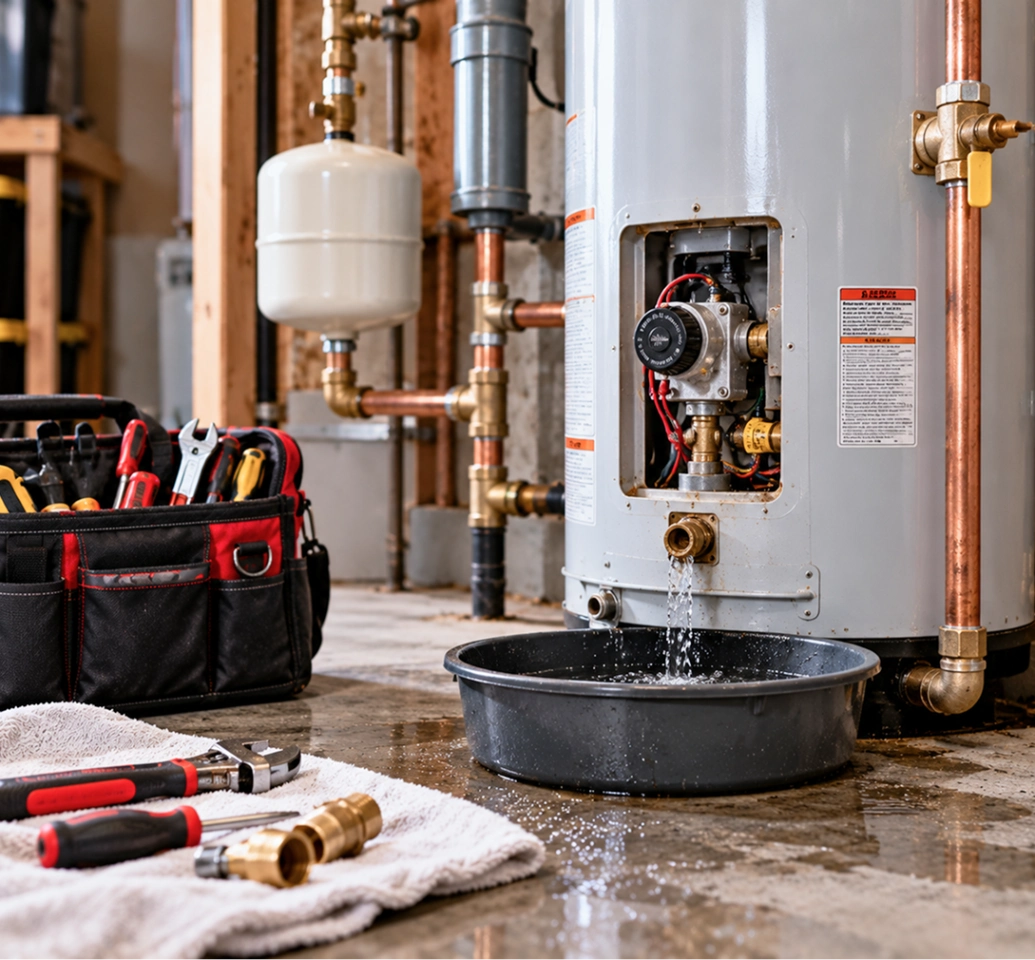
Check the serial number, not your memory. Most manufacturers encode the build date into it, and a tank past ten or twelve years is a water heater replacement waiting to be scheduled. Rusty water from the hot side only, corrosion around the fittings, or a bill creeping up while nothing else in the house changed are all the same story: the unit is working harder to do less.
Leaks and Sediment Noise
A puddle under the tank is the end of the conversation. Any water at the base means the tank has failed, and it will not get better. Sediment noise is earlier and more fixable, but it’s the tank telling you it’s scaling up inside.
On a well, this happens faster. Iron and manganese leave sediment, and low-alkalinity water eats the anode rod that’s supposed to protect the lining. A heater that died at six years on a Seabeck or Hansville well usually died of water chemistry.

Tank, Tankless, and High-Efficiency Options
Traditional Tank Water Heaters
A tank is still the right answer for most Kitsap homes. Lower up-front cost, simpler water heater installation, and a straight swap when the replacement matches what is already there. If your current setup works and the house hasn’t changed, replacing like for like is usually the sensible move.
Tankless and Heat Pump Upgrades
Tankless gives you endless hot water and your floor space back, at a higher up-front cost and usually gas and venting changes. Heat pump units are efficient but need air volume and clearance around them. Both are worth considering as a replacement, and we’ll tell you honestly whether the payback works for your house. Full detail on tankless.
The Brands on the Truck
Bradford White and A.O. Smith are the tank lines Alex works with, Navien when a job goes tankless. We are not a certified installer for any of them, which is worth saying plainly, and parts availability matters as much as the badge on the front when something needs fixing in year three.
Water Heater Maintenance That Buys You Years
The Annual Flush and the Anode Rod
Flushing the tank once a year clears the sediment before it insulates the burner and starts cooking the bottom of the tank. It’s a short job and it is the single cheapest thing you can do to a water heater.
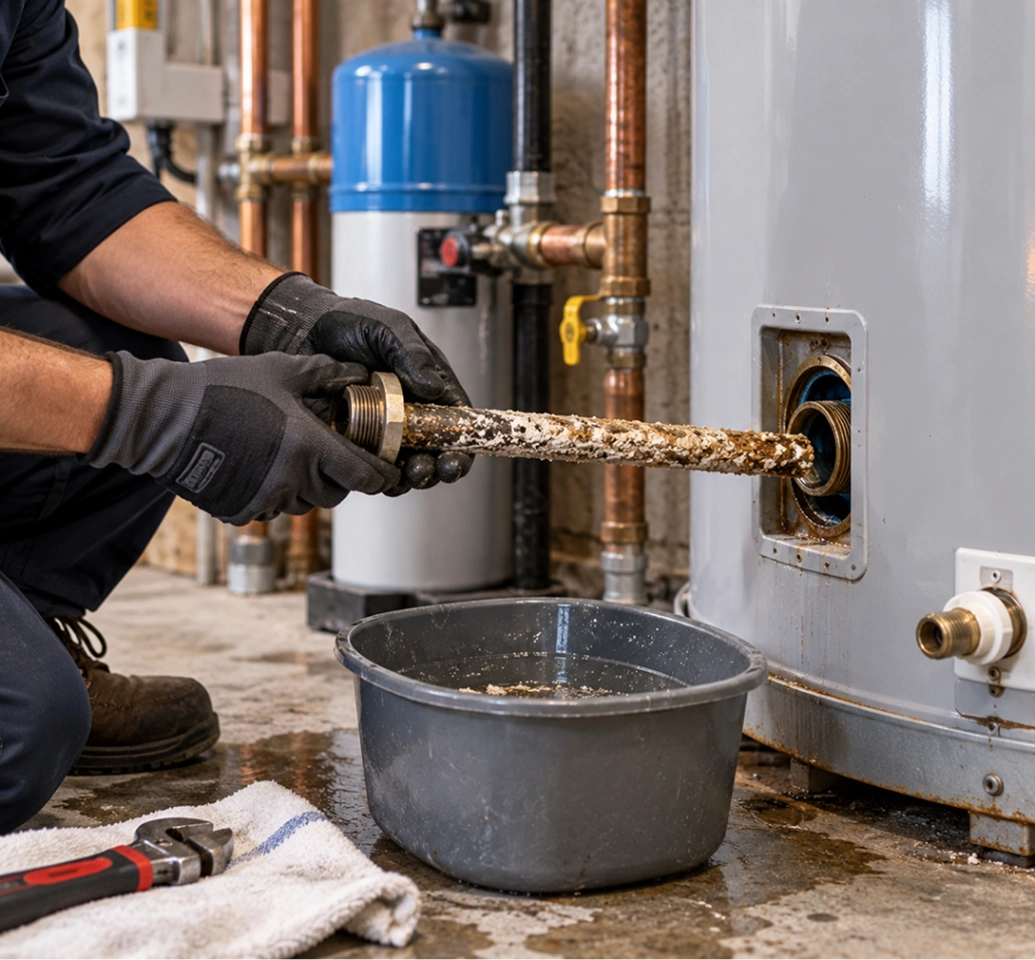
The anode rod is the part nobody knows about. It’s a sacrificial metal rod that corrodes so the tank lining doesn’t, and when it’s gone the tank starts dissolving instead. Checking it every couple of years, and swapping it when it’s spent, can add years to a heater. Aggressive well water chews through a rod faster, and so does hardness, which is why hard water scale protection buys the tank time as well as the rod.
Expansion Tank and Safety Checks
A closed system needs somewhere for hot water to expand. If a check valve, pressure reducing valve, or backflow assembly sits on your service, heated water can’t push back into the main, so it pushes against your pipes and the T&P valve instead. A thermal expansion tank absorbs that. We check for one on every replacement and fit one where it’s missing.
We also test the T&P relief valve and confirm the discharge pipe runs where it should. It is the one safety device on the unit and the one most often left seized.

Why Kitsap Homeowners Call Us for Water Heaters
More Than a Thousand of These, Personally
That thousand-plus figure is Alex’s own, earned over roughly ten years on the tools, most of them before A to Z existed. It is not a company total and we don’t present it as one. What it buys you is a plumber who has seen your exact garage, your exact venting problem, and your exact undersized circuit before.
Licensed, Local, and Already This Side of the Water
Alex is a Washington certified residential specialty plumber and he lives on the peninsula. A job in Silverdale, Port Orchard, Poulsbo, Gig Harbor, or Belfair doesn’t start with a ferry queue. An inspector will occasionally flag something small, a strap an inch out of position, and it gets sorted on the visit. Nothing has failed outright.
The Done Right Guarantee
A full year on parts and labor, covering the work as well as the component. It is the family rule about doing a job once, written down with a term attached rather than left as a saying. Offers and monthly payments.
What Kitsap Says: "Wish We'd Found You Sooner"
See what homeowners around Kitsap have to say about working with Alex and the A to Z team.

A to Z plumbing is by far the best plumbing company out there. They are so fast to respond to your issues. They are reasonably priced and won’t charge you for things you don’t need. 100% recommend.

August 23, 2023

Alex and Michael have done outstanding work on three different plumbing issues. They respond quickly to scheduling work, show up on time, and work efficiently. They are very knowledgeable about each issue I presented. They quote pricing up front so there are no surprises. They are fair in their pricing. They are friendly and always leave a clean work area. I would highly recommend A to Z Plumbing. I know we will ALWAYS call them for any plumbing needs.
July 17, 2024
Great customer service, quality workmanship and Alex is just a great guy to work with.
August 8, 2026
My husband and I are very pleased with Alex’s work. He is very professional and trustworthy We enjoyed working with him. We will definitely use him again and be happy to refer him and his company to anyone looking for a reliable and service-oriented plumber!
September 9, 2025
Alex and Tanner were amazing! We had an interesting, and I would say challenging, situation that needed to be addressed in several ways. They were both professional and competent. Alex returned messages and calls promptly, and addressed all the hiccups we encountered quickly. He is a kind and honorable person – we are SO glad we called A to Z plumbing, and will absolutely call them for all our plumbing needs!
September 9, 2025
10/10 Would recommend. A to Z plumbing came out to repair a busted water main for me as an emergency service. Alex and his team arrived within 15 minutes of my emergency and remained cool, calm and collected. They worked together to solve the problem quickly and efficiently. They were knowledgeable and professional from start to finish. I couldn’t be happier with their service and I will be using them again for future plumbing related services. A to Z plumbing had clear pricing that was consistent with their industry. If you want something done right, don”t do it yourself. Just call A to Z plumbing and enjoy your peace of mind.
March 9, 2026


Questions Homeowners Ask Before We Come Out
What size water heater do I need?
Washington sets a minimum by first hour rating rather than tank size, scaled to your bedroom and bathroom count. A three bedroom, two bath house needs a first hour rating of 62 gallons. We check the rating on the Energy Guide label against the house rather than guessing from the old tank, which may have been undersized to begin with.
Does Washington require seismic straps on a water heater?
Yes. State code requires a tank to be anchored against horizontal movement with straps at two points, in the upper third and the lower third of the unit, keeping at least four inches clear above the controls. Every install we do goes out strapped, and it’s one of the first things an inspector looks at.
Do you pull the permit?
Yes, on every water heater replacement that needs one. Some homeowners are surprised a swap requires it. The permit is what gets an inspector to check the venting, the strapping, and the expansion tank, which is protection for you rather than paperwork for us.
Should I repair or replace?
Under roughly ten years with a sound tank, repair is often the better call. Past ten, or with any water at the base of the unit, replacement usually wins. Alex will tell you which one your heater is, including when the answer is the cheaper one.
How long does a replacement take?
A straight tank swap is generally a half day. It runs longer when venting has to change, an expansion tank needs adding, the electrical needs work, or the heater is moving to a different spot to meet code. You’ll know which of those apply before we start.
Why did my last water heater only last six years?
Usually water chemistry. Much of unincorporated Kitsap is on private wells, and low-alkalinity water strips the anode rod that protects the tank lining, while iron and manganese build sediment at the base. Once the anode is gone the tank corrodes from the inside. Treating the water or checking the anode more often both extend the next one considerably.